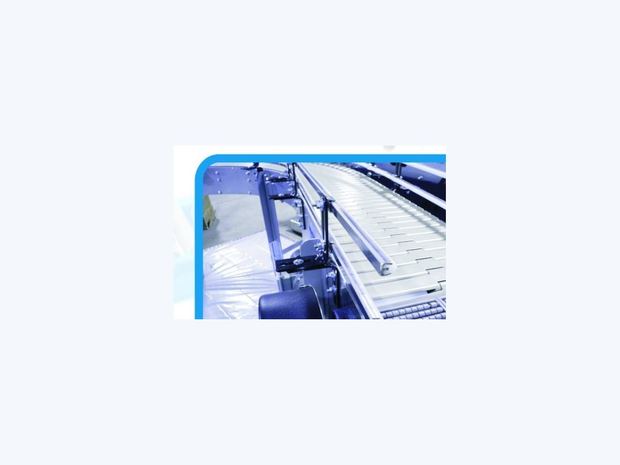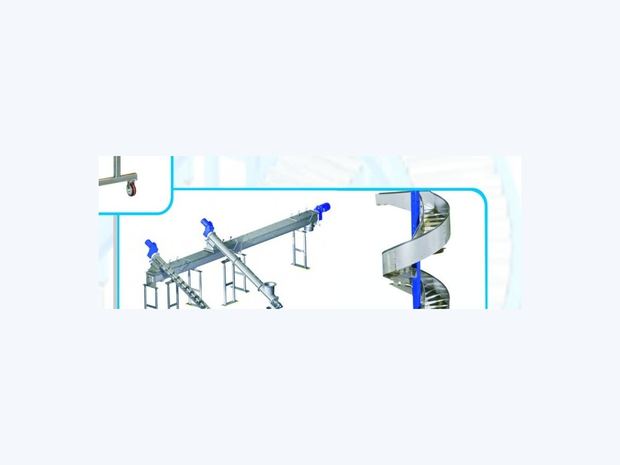
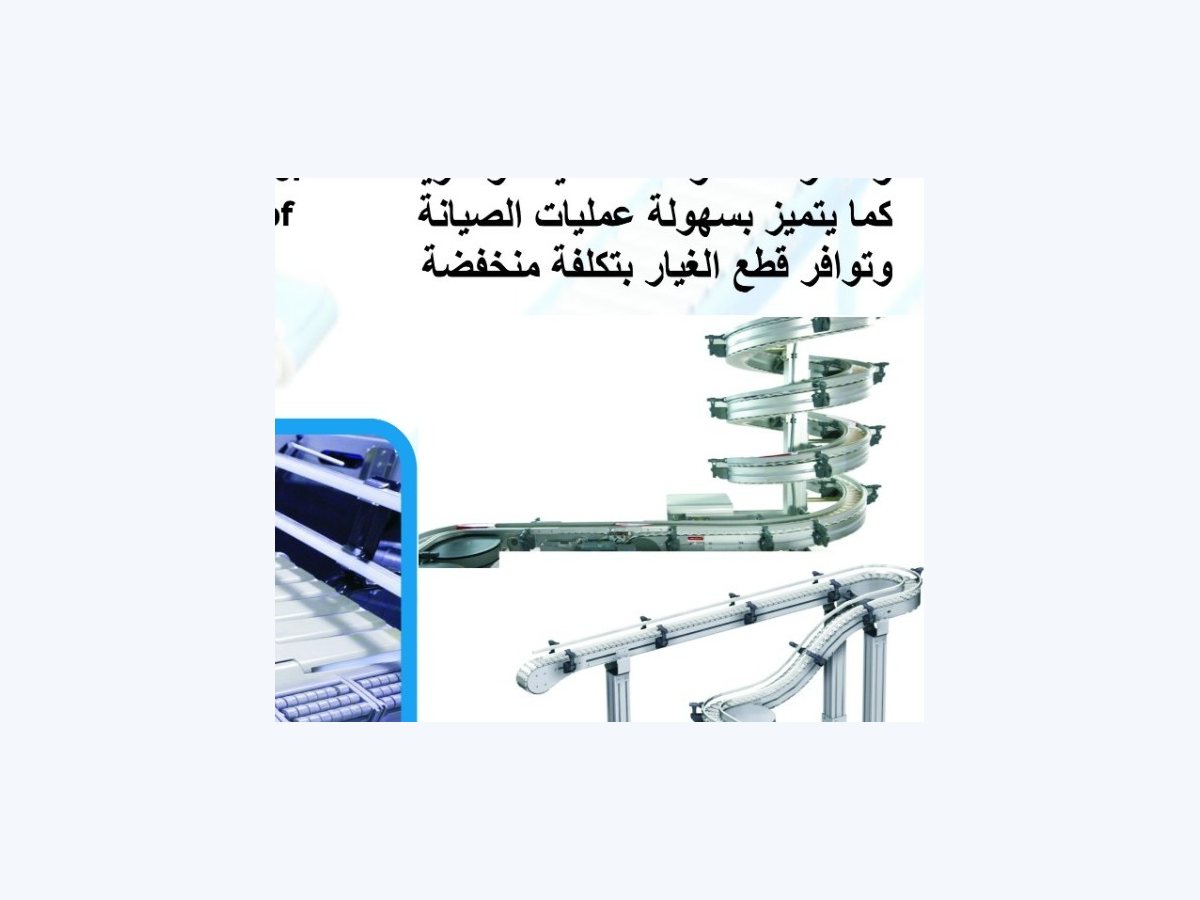
Slat chain conveyors are the best belt type for moving glass, tin or plastic containers in every field. Chains are manufactured in engineering plastic or stainless steel, running straight or around corners.
Why slat chains specifically on filling lines? Because a bottle stands on a small base and moves at speed. It needs a hard, flat, stable surface — not an elastic one that stretches and relaxes. A slat chain provides exactly that, and it also allows something a belt cannot: product can stand still while the chain keeps sliding underneath it (accumulation), which is the basis of any filling line whose stations run at different speeds.
Plastic or stainless?
Thermoplastic chain (such as the maxxTop 821 series) is the default: lower friction, quieter, lighter and cheaper. Stainless becomes necessary in two cases — high operating temperature, as on pasteurisation lines, or heavy loads such as large glass containers.
Corners
Side-flexing chain turns corners and climbs spiral paths. That is not cosmetic: it recovers real floor space and lets you link levels without a separate conveyor for every leg of the route.
The parts that decide the line's life
Three small components govern performance more than the chain itself:
1. UHMW-PE wear strips — low friction coefficient, near-zero water absorption, continuous service to roughly 80 °C. This is the surface the chain actually slides on. 2. Molded idler wheels — standard sizes per series; they set chain tension and the smoothness of the return run. 3. Support bases and articulated feet — AISI 304 spindle and nut on a reinforced polyamide base. Any twist or height mismatch between them shows up immediately as chain mistracking.
The broader advantage of slat chains is that maintenance is straightforward and spares are available at low cost — the line comes back up quickly, which is what ultimately counts.